


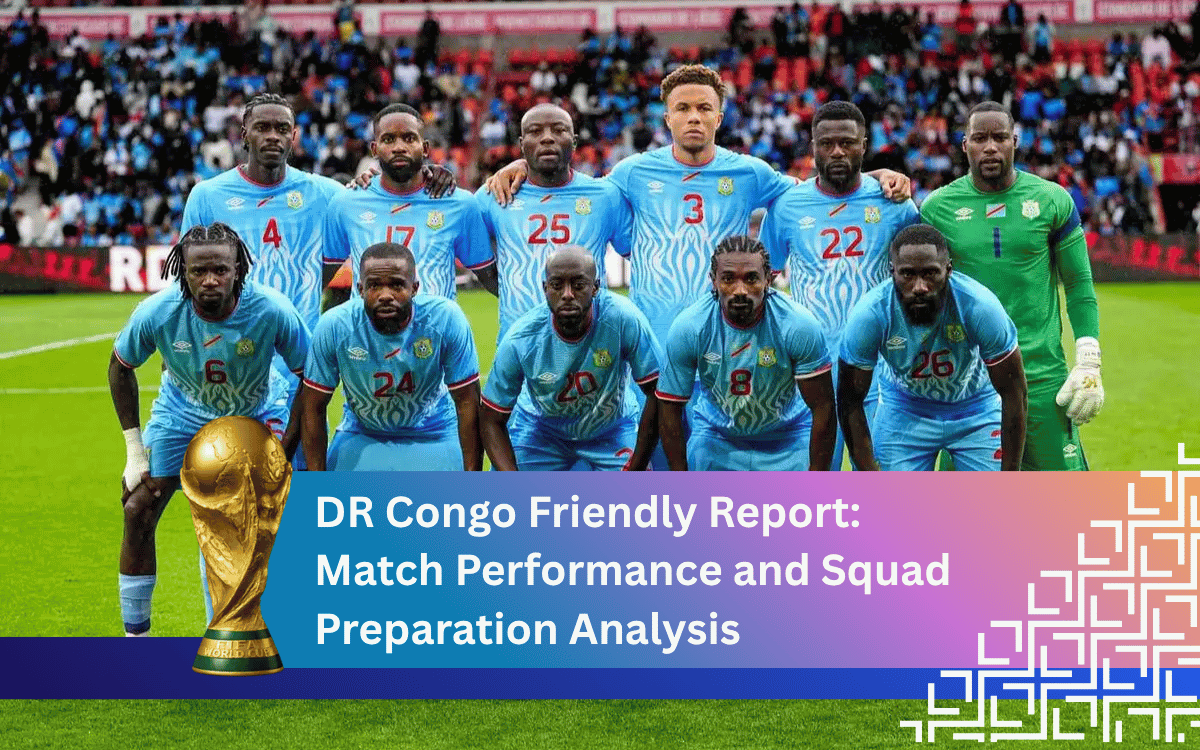
The DR Congo friendly report outlines how the national team is sharpening its tactical structure, evaluating squad depth, and building competitive rhythm ahead of the FIFA World Cup 2026 qualifiers play-off tournament. The latest friendly fixture serves as a crucial checkpoint in assessing readiness for high-stakes international competition.
This preparatory match reflects the team’s ongoing effort to refine coordination, strengthen defensive organization, and enhance attacking efficiency as they approach one of the most decisive phases of World Cup qualification.
DR Congo Use Friendly Match to Build Momentum for World Cup 2026 Qualifiers
The latest international friendly involving the DR Congo national team is part of a structured preparation plan aimed at optimizing performance ahead of the FIFA World Cup 2026 qualifiers play-off stage. With qualification pressure increasing, these fixtures provide an essential platform for technical assessment and tactical experimentation.
Rather than focusing solely on results, the coaching staff prioritized performance indicators such as pressing intensity, transition speed, and positional discipline. These elements are considered vital for competing against higher-ranked international opponents in the upcoming qualifiers.
The friendly also allowed the technical team to simulate match conditions similar to those expected in the play-off tournament, where margins for error are expected to be minimal.
Tactical Adjustments Highlight Strategic Direction
One of the central takeaways from the DR Congo friendly report is the tactical evolution under current preparations. The team has been working on a more balanced structure that ensures stability between defense and attack.
Key tactical focus areas include:
- Improving compactness in defensive shape during opposition transitions
- Enhancing ball retention under pressure in midfield zones
- Increasing efficiency in final-third decision-making
- Strengthening coordinated pressing to recover possession quickly
These adjustments indicate a shift toward a more disciplined and structured playing style, designed to withstand the intensity of World Cup qualifying matches.
The coaching staff appears committed to building a system that is adaptable, allowing the team to switch between controlled possession and direct attacking play depending on match scenarios.
Squad Rotation and Player Evaluation in Focus
The friendly match also served as an opportunity to evaluate squad depth and individual performances. With the FIFA World Cup 2026 qualifiers requiring consistency over multiple fixtures, player rotation has become a key strategic component.
Several players were assessed in different roles to test versatility and tactical adaptability. This approach helps identify reliable options for the final squad selection for the play-off tournament.
From a performance standpoint, the technical staff focused on:
- Player fitness levels and match endurance
- Decision-making under pressure
- Communication and coordination across defensive lines
- Offensive creativity in structured build-up phases
Such evaluations are crucial in determining the final competitive squad capable of handling the demands of international qualification football.
Defensive Stability and Midfield Control as Priority Areas
The DR Congo friendly report highlights two major performance priorities: defensive organization and midfield control. These areas are often decisive in tightly contested international matches, especially in qualification tournaments.
Defensively, the team has been working on maintaining shape during quick transitions, reducing space between lines, and limiting opposition chances in high-risk zones.
In midfield, emphasis has been placed on improving control during possession phases, ensuring smoother transitions from defense to attack, and reducing unnecessary turnovers.
This dual focus reflects a broader strategy aimed at building a balanced team capable of both resisting pressure and initiating structured attacking moves.
Preparation Strategy for FIFA World Cup 2026 Qualifiers Play-Off
As the FIFA World Cup 2026 qualifiers approach the play-off stage, DR Congo’s preparation strategy is becoming increasingly defined. Friendly matches like this one play a critical role in bridging the gap between training ground development and competitive execution.
The preparation framework includes:
- Tactical refinement through controlled match environments
- Fitness conditioning to meet high-intensity demands
- Psychological readiness for knockout-style pressure situations
- Continuous evaluation of player combinations and formations
This systematic approach is designed to ensure that the team enters the qualifiers with maximum cohesion and clarity in game plans.
Coaching Philosophy and Long-Term Vision
Beyond immediate qualification goals, the DR Congo setup appears focused on long-term development. The friendly match reflects a broader philosophy centered on structured growth, tactical discipline, and competitive resilience.
The coaching staff is prioritizing sustainable performance improvements rather than short-term results. This includes developing a consistent playing identity that can be maintained across multiple qualification cycles and international tournaments.
Such an approach is increasingly important in modern international football, where adaptability and tactical intelligence often determine success at the highest level.