

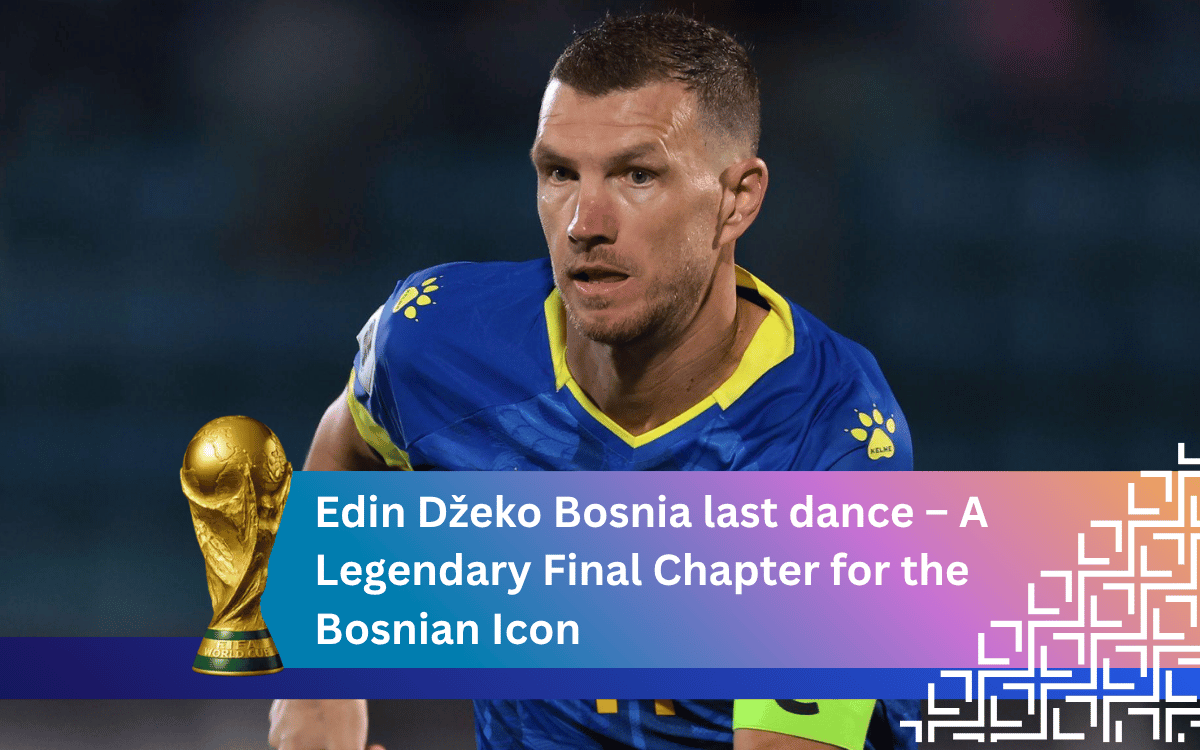
Edin Džeko Bosnia last dance marks the emotional beginning of the striker’s potential farewell journey with the national team during the 2026 FIFA World Cup qualifying cycle. The Bosnia and Herzegovina captain has suggested this campaign could be his final chapter on the international stage, signaling the end of an era defined by leadership, goals, and historic contributions to his country football identity.
A Legendary Career Approaches Its Final International Chapter
Edin Džeko, one of Bosnia and Herzegovina’s most iconic footballers, appears to be preparing for a symbolic “last dance” with the national team as the 2026 FIFA World Cup qualification campaign unfolds.
At 38 years old, the veteran striker remains a central figure for Bosnia, both on and off the pitch. His leadership has long been a cornerstone of the national squad, guiding younger players while continuing to deliver crucial performances in competitive fixtures.
The “last dance” narrative reflects a growing understanding within Bosnian football that a generational transition is approaching. While Džeko has not officially confirmed retirement, his recent reflections suggest that the road toward the 2026 World Cup could represent his final attempt to lead his nation onto football’s biggest stage.
For Bosnia and Herzegovina, a country that has often relied on Džeko’s brilliance in key moments, this phase carries both emotional weight and sporting urgency.
The Symbol of a Golden Generation in Transition
Džeko’s international career has been synonymous with Bosnia and Herzegovina’s most successful football era. Since making his debut, he has evolved into the team’s all-time leading scorer and a consistent figure in European and World Cup qualification campaigns.
His presence helped Bosnia reach its first-ever FIFA World Cup in 2014, a historic milestone that still defines the national team’s identity. That achievement placed Džeko among the most influential athletes in the country’s sporting history.
Now, the “Edin Džeko Bosnia last dance” storyline highlights the natural cycle of transition in international football:
- A veteran leader nearing the end of his national career
- A younger generation waiting to step into leadership roles
- A national team attempting to rebuild competitiveness in Europe
- A final qualifying push that blends ambition with nostalgia
This shift is not only about replacing goals but also about replacing experience, mentality, and leadership—qualities that Džeko has embodied for nearly two decades.
Bosnia and Herzegovina’s 2026 World Cup Qualification Challenge
The road to the 2026 FIFA World Cup presents both opportunity and difficulty for Bosnia and Herzegovina. Expanded tournament formats offer more qualification chances, but European competition remains intense, with established national teams dominating group stages.
Džeko’s potential final campaign adds emotional motivation for teammates and supporters alike. His influence often extends beyond scoring, contributing to tactical discipline, team morale, and composure in high-pressure matches.
In recent qualification cycles, Bosnia has struggled with consistency, often falling short despite strong individual performances. The current cycle represents a chance to reset expectations while leveraging the experience of senior players like Džeko.
Key factors shaping Bosnia’s qualification hopes include:
- Defensive stability against higher-ranked European opponents
- Midfield creativity to support attacking transitions
- Squad depth beyond veteran leadership
- Maximizing home advantage in Sarajevo fixtures
As the team prepares for competitive matches, Džeko’s role remains central—not just as a striker, but as a unifying figure in the dressing room.
Leadership Beyond Goals: Džeko Lasting Influence
While Edin Džeko’s goal-scoring record is remarkable, his influence on Bosnia and Herzegovina football extends far beyond statistics. His leadership has been a stabilizing force through coaching changes, tactical shifts, and generational turnover.
Young players entering the national setup often cite his professionalism and work ethic as defining examples. His ability to remain competitive at the highest level of European football well into his late 30s has also set a benchmark for longevity.
The “last dance” phase is therefore not only about ending a career but about passing on a football culture. Bosnia’s next generation will inherit a team shaped by Džeko’s standards—both in ambition and discipline.
This transitional period also raises strategic questions for the national team:
- Who will replace Džeko’s goal output?
- Can Bosnia maintain attacking efficiency without its all-time leading scorer?
- How will the team redefine its identity post-Džeko era?
These questions underline the magnitude of his departure whenever it eventually becomes official.
The Emotional Weight of a Farewell Cycle
The phrase “last dance” carries strong emotional symbolism in sports, often associated with final campaigns of legendary athletes. In Džeko’s case, it reflects not only personal career timing but also national sentiment.
For fans of Bosnia and Herzegovina, Džeko represents more than a striker—he is a symbol of national pride, resilience, and global recognition. His performances have often united supporters during moments of uncertainty, offering hope in major qualification battles.
As the 2026 cycle progresses, every match could carry added emotional significance. Whether Bosnia qualifies or not, this period is likely to be remembered as the closing chapter of an extraordinary international journey.
Legacy of Edin Džeko in Bosnian Football History
Regardless of how the 2026 qualification campaign unfolds, Edin Džeko’s legacy is already firmly established. He stands as:
- Bosnia and Herzegovina’s all-time leading scorer
- A key figure in the nation’s first World Cup qualification in 2014
- One of the most successful football exports from the Balkans
- A long-standing captain and leader across multiple generations
His influence spans club and international football, but his emotional connection with the national team remains unique. The “Edin Džeko Bosnia last dance” narrative is therefore not just about an ending—it is about celebrating one of the most important sporting careers in the country’s history.
As Bosnia looks toward the future, the challenge will be preserving the competitive spirit and identity that Džeko helped build. His final campaign, whenever it concludes, will mark the end of an era—but also the foundation for what comes next in Bosnian football.