



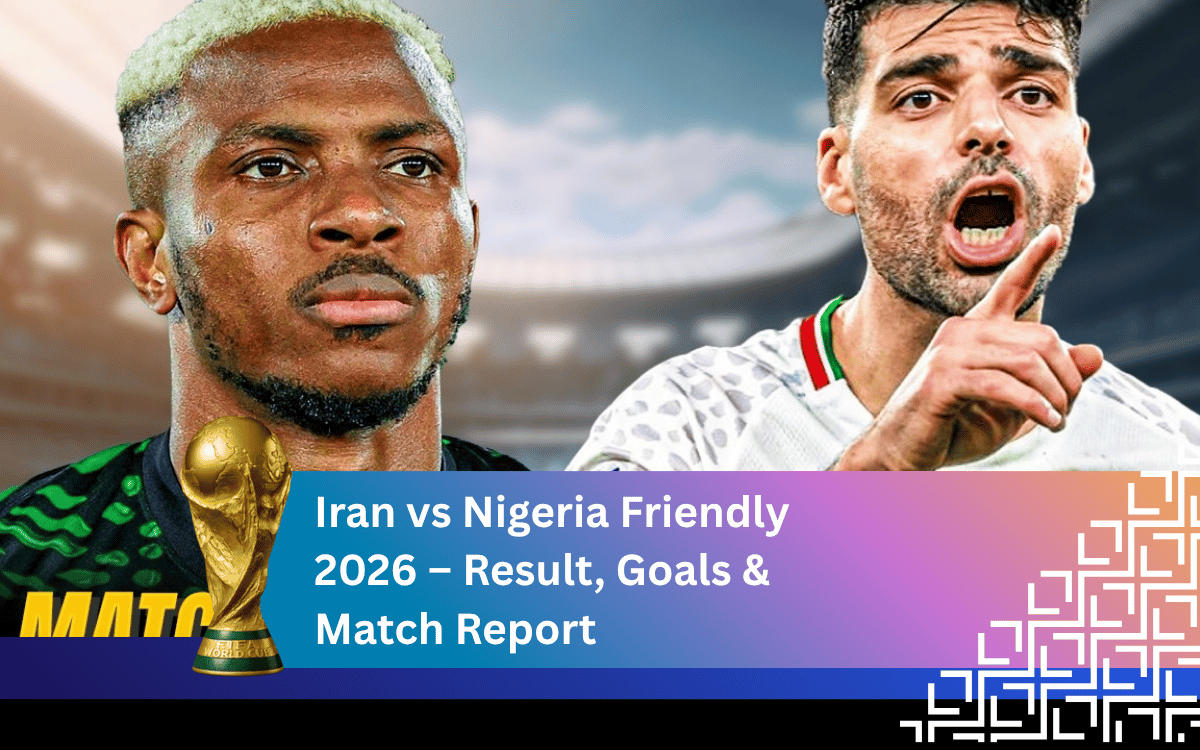
Iran vs Nigeria friendly in Antalya, Turkey, turned into a moment of remembrance as Iran’s national football team paid tribute to victims of a devastating school strike that killed more than 165 people, most of them children. The ceremony took place before kickoff as players honored the dead during the national anthem, transforming a World Cup warm-up match into a highly emotional event.
The match, played on March 27, 2026, was part of Iran’s preparation for the upcoming 2026 FIFA World Cup. Nigeria won the friendly 2-1, but the sporting result was overshadowed by the pre-match tribute and growing geopolitical tensions surrounding the region.
Pre-Match Tribute: School Backpacks and Black Armbands
Before the match began, Iranian players stepped onto the pitch carrying small school backpacks, placed carefully in front of them during the national anthem. The gesture symbolized the children killed in a February 28 strike on an elementary school in southern Iran.
In addition to the backpacks, players also wore black armbands as a sign of mourning. The emotional scene was widely shared in broadcast footage from Antalya, a Turkish coastal city where the match was relocated due to regional security concerns.
Key elements of the tribute included:
- Small pink and purple school backpacks placed on the pitch
- Silent remembrance during the national anthem
- Black armbands worn by Iranian players
- A collective team gesture of mourning before kickoff
The Deadly School Strike at the Center of the Gesture
The tribute was linked to a February 28 strike that reportedly hit a school in southern Iran, killing more than 165 people, the majority of them children. The incident has drawn strong international criticism and condemnation from human rights groups and the United Nations.
While responsibility for the attack has not been officially accepted by either the United States or Israel, the strike has become a major point of political and diplomatic tension. Investigations and competing claims continue, further fueling regional instability.
Iranian officials have framed the football team’s gesture as a symbolic remembrance of civilian victims, particularly schoolchildren, in the aftermath of the attack.
Why the Match Was Played in Turkey?
The fixture between Iran and Nigeria was not originally planned for Antalya. It was moved to Turkey due to escalating tensions in the Middle East and concerns over travel and security conditions in nearby regions.
Antalya has increasingly become a neutral venue for international friendlies involving teams from politically sensitive regions. The city hosted multiple warm-up fixtures ahead of the 2026 World Cup, including matches involving Iran, Jordan, and other national teams preparing for global competition.
World Cup Pressure and Rising Political Tensions
Beyond the emotional tribute, the match highlighted broader uncertainty surrounding Iran’s participation in the 2026 FIFA World Cup, co-hosted by the United States, Mexico, and Canada.
Iran is scheduled to play group-stage matches in the United States, but reports suggest ongoing diplomatic friction and security concerns. Iranian officials have even discussed relocating matches due to fears linked to recent military escalation in the region.
FIFA has so far maintained that the tournament will proceed as scheduled, emphasizing stability and continuity despite political pressure.
This situation places additional scrutiny on Iran’s national team, which continues to balance sporting commitments with a highly sensitive geopolitical backdrop.
Nigeria’s Role and Sporting Context
While the emotional focus was on Iran’s tribute, Nigeria’s team remained focused on match preparation. The Super Eagles used the friendly as part of their own international development cycle ahead of future tournaments.
Despite the competitive result—a 2-1 victory for Nigeria—the fixture was largely viewed as a preparation match for both sides, offering tactical experimentation and squad assessment ahead of major international competitions.
Football as a Platform for Global Messages
The Antalya friendly once again demonstrated how international football often reflects global tensions beyond the pitch. Iran’s symbolic tribute highlighted how sport can serve as a platform for national grief, political messaging, and international attention.
The combination of:
- Humanitarian remembrance
- Regional conflict
- World Cup qualification pressure
- Neutral venue logistics
created a match that extended far beyond football itself.