


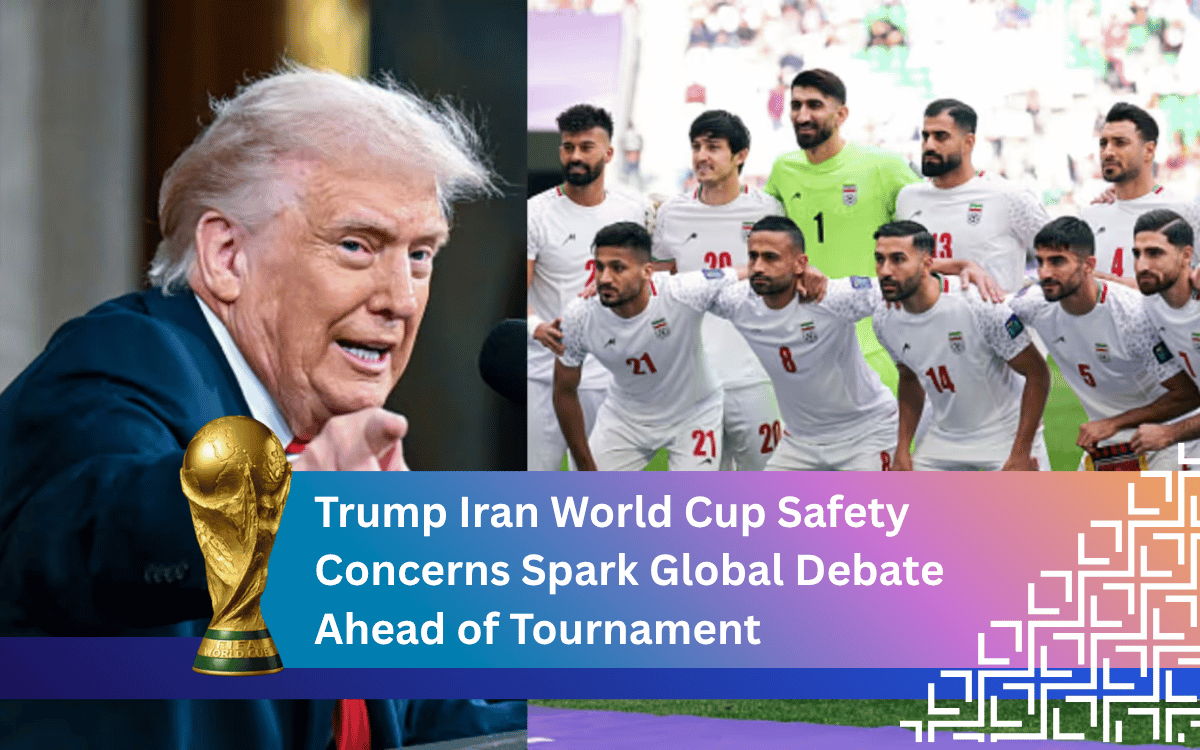
Donald Trump Iran World Cup safety concerns have ignited international debate after the U.S. president suggested Iran’s national football team should reconsider participating in the 2026 FIFA World Cup due to potential risks. His remarks come amid escalating geopolitical tensions in the Middle East and ongoing uncertainty over Iran’s final participation in the tournament.
Trump emphasized that while Iran is technically welcome to compete, he believes their presence may not be “appropriate” given the security environment and the possibility of threats to players and staff.
Trump Statement and the Core Safety Argument
In comments shared on his social media platform, Trump said the Iranian national team should be allowed to participate but questioned whether it would be safe for them to do so. He framed his position as a precautionary warning rather than an exclusionary decision.
According to Trump, the concern is rooted in the broader security situation following military escalations between the United States, Israel, and Iran earlier this year. He suggested that the volatile conditions could place athletes at unnecessary risk if they travel and compete in U.S.-hosted matches.
The message, while not an official policy change, has added a new layer of political pressure around an already sensitive sporting event.
Iran Qualification and Growing Uncertainty
Iran has already secured qualification for the expanded 2026 FIFA World Cup, which will be jointly hosted by the United States, Canada, and Mexico. The team is scheduled to play its group-stage matches in U.S. cities, including Los Angeles and Seattle, depending on final scheduling.
However, uncertainty has grown following conflicting signals from Iranian officials. Iran’s sports authorities previously suggested that participation could be reconsidered due to political and security concerns.
This has created a rare situation where a qualified team’s participation remains unclear not because of sporting reasons, but due to diplomatic and safety-related tensions.
FIFA Role and Pressure to Maintain Neutrality
FIFA has found itself at the center of the controversy, balancing its commitment to neutrality with increasing political pressure from both sides.
Earlier communications from FIFA leadership reportedly included assurances that all qualified teams, including Iran, would be welcomed. FIFA president Gianni Infantino has consistently emphasized that the World Cup is intended to be a unifying global event that transcends political conflict.
However, FIFA has yet to issue a definitive public ruling on Iran’s participation in light of the latest statements. The governing body is expected to address the situation closer to its upcoming decision-making meetings ahead of the tournament.
Geopolitics Meets Global Sport
The controversy highlights the growing intersection between international politics and major sporting events. The 2026 World Cup, already one of the most geographically complex tournaments in history, is now facing added scrutiny due to global instability.
Key factors influencing the debate include:
- Ongoing tensions between the United States and Iran following military escalation earlier in 2026
- Security concerns for teams, officials, and traveling supporters
- Diplomatic disagreements over hosting responsibilities and neutrality
- Historical precedent of sports being affected by international conflict
While international football has often been used as a platform for diplomacy, the current situation underscores how fragile that balance can be.
Reactions and Broader Implications for the 2026 World Cup
Trump’s remarks have drawn mixed reactions across political and sporting communities. Supporters argue that athlete safety must remain the top priority, especially in a volatile geopolitical climate. Critics, however, warn that political statements risk undermining FIFA’s authority and the spirit of global competition.
Iranian football officials have also responded strongly in past statements, insisting that participation decisions should remain under FIFA’s jurisdiction rather than political influence. They argue that the responsibility for ensuring safety lies with host nations and the tournament organizer.
This dispute raises broader questions about how future international tournaments will navigate political conflicts involving qualified teams.
What Happens Next for Iran and FIFA?
At this stage, Iran remains officially qualified for the 2026 World Cup, and no formal exclusion has been announced by FIFA. However, the situation remains fluid, with several possible outcomes:
- Iran proceeds as planned with full participation
- Iran voluntarily withdraws due to security concerns
- FIFA intervenes with safety reassurances or alternative arrangements
- Diplomatic pressure influences scheduling or hosting logistics
With the tournament approaching, FIFA faces increasing urgency to resolve the issue in a way that preserves both safety and competitive integrity.