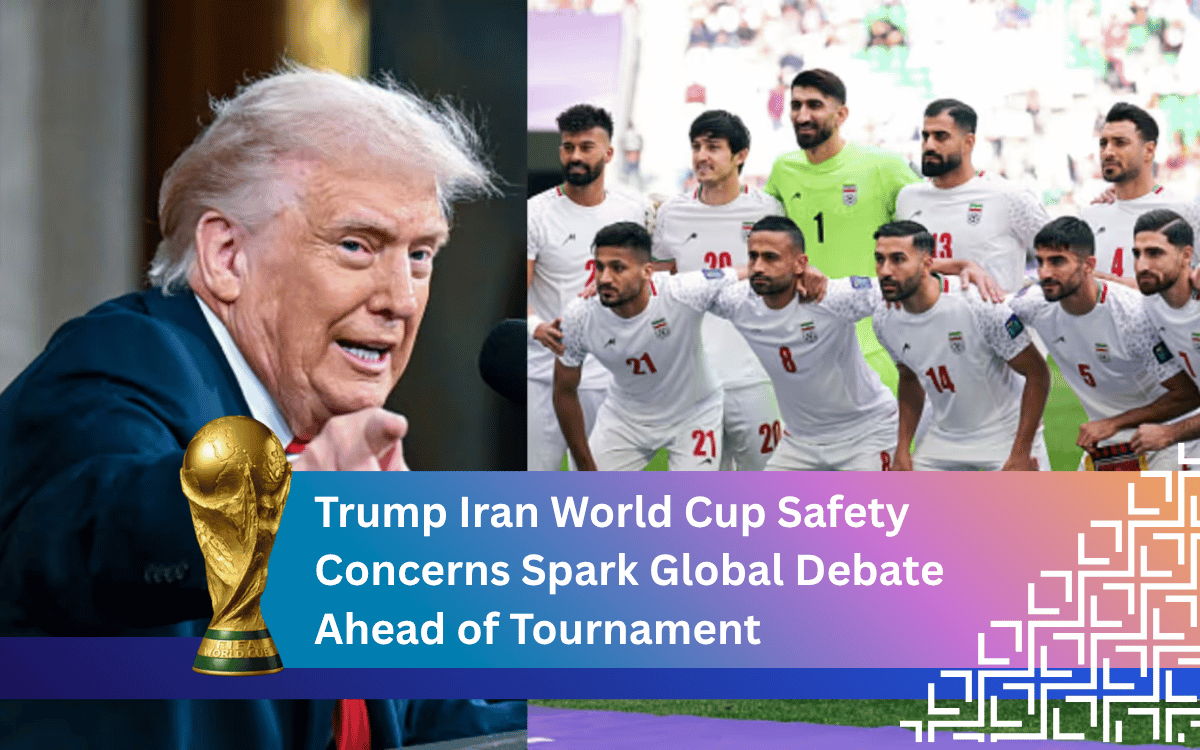



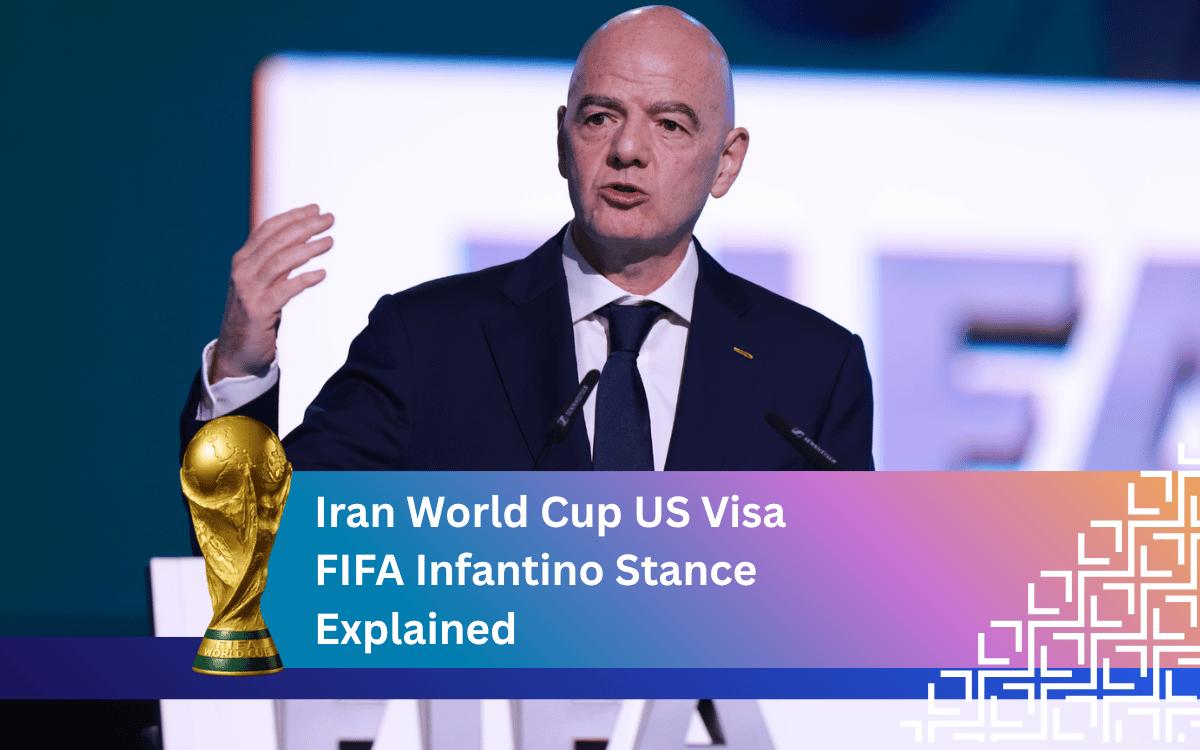
Iran participation in the Iran World Cup US visa FIFA Infantino debate has sparked renewed political and sporting tensions ahead of the 2026 FIFA World Cup hosted across the United States, Canada, and Mexico. Concerns are growing over whether Iranian players, staff, and supporters will face visa restrictions entering the United States, placing FIFA’s neutrality principles under scrutiny.
The situation has drawn attention to FIFA president Gianni Infantino, who is now facing pressure to ensure that geopolitical disputes do not interfere with tournament access or the integrity of global football.
Rising Diplomatic Tensions Ahead of 2026 World Cup
The controversy stems from longstanding political tensions between the United States and Iran, which have historically influenced travel and visa policies. With the US set to host a significant number of matches in the expanded 48-team World Cup, questions have emerged over whether Iranian nationals linked to the national team will be granted entry without obstruction.
According to reporting from The Independent, football officials and stakeholders have expressed concern that visa complications could undermine the tournament’s inclusivity. Iran’s qualification scenario has intensified the issue, as the country remains one of Asia’s strongest footballing nations and a consistent World Cup participant in recent editions.
The debate is not only about sport but also about FIFA’s ability to enforce its principle that football should remain separate from political disputes.
FIFA’s Neutrality Principle Under the Spotlight
At the center of the discussion is FIFA’s long-standing commitment to neutrality. The governing body has repeatedly stated that World Cup participation should not be influenced by political disagreements between nations.
However, the Iran World Cup US visa FIFA Infantino issue highlights the challenges of applying this principle when a host nation’s foreign policy intersects with global sporting participation.
Gianni Infantino has previously emphasized that FIFA will work with host countries to ensure that all qualified teams can enter and compete freely. Still, critics argue that the governing body must provide clearer guarantees, especially given the scale and political complexity of a multi-nation tournament hosted partly in the United States.
Key concerns raised by analysts include:
- Potential delays in visa approvals for Iranian players and officials
- Uncertainty surrounding travel permissions for fans
- Risk of political pressure affecting sporting access
- Lack of publicly detailed FIFA contingency plans
These concerns have fueled debate over whether FIFA can fully insulate its competitions from international politics.
Iran Football Position and World Cup Importance
Iran has established itself as one of Asia’s most consistent football teams, regularly qualifying for the World Cup and maintaining strong performances in Asian competitions. For Iranian players, participation in the World Cup represents both a sporting achievement and a global platform.
The stakes are therefore particularly high. Any restriction on access could not only impact team preparation but also raise broader questions about fairness in international sport.
Iranian football authorities have in past tournaments raised concerns about logistical and political barriers affecting participation. The 2026 edition, however, presents a more complex challenge due to the scale of US involvement as a host nation.
US Hosting Role and Policy Challenges
The United States will host the majority of matches in the 2026 World Cup, sharing duties with Canada and Mexico. This makes US immigration and visa policy a central factor in the smooth execution of the tournament.
While sporting visas are typically processed under special international event frameworks, geopolitical tensions can complicate standard procedures. This is particularly relevant in cases involving countries subject to heightened diplomatic restrictions.
FIFA is expected to coordinate closely with US authorities to ensure compliance with tournament obligations, but questions remain over how such assurances will be enforced in practice.
Experts argue that the situation tests the limits of sports diplomacy, where international federations rely heavily on sovereign governments to facilitate global competitions.
Gianni Infantino’s Balancing Act
FIFA president Gianni Infantino now faces one of the more politically sensitive challenges of the 2026 build-up. His leadership has often focused on expanding the global reach of football, including increasing World Cup participation and commercial growth.
However, the Iran situation underscores the difficulty of balancing political realities with sporting ideals.
Infantino has previously insisted that football must remain inclusive and accessible to all qualified nations. Yet critics argue that FIFA must go beyond statements and establish enforceable mechanisms to ensure compliance from host countries.
The credibility of the tournament could be affected if any qualified team experiences barriers to entry, particularly one as established as Iran.
Broader Implications for International Football
The debate extends beyond Iran and the United States. It raises wider questions about how international sporting bodies navigate geopolitical conflicts in an increasingly divided global landscape.
The World Cup is designed to be a unifying event, but hosting it across multiple countries introduces complex legal and diplomatic layers. The Iran World Cup US visa FIFA Infantino issue is therefore being viewed as a test case for future tournaments.
Sports governance experts suggest that FIFA may need to strengthen formal agreements with host governments to prevent political interference in player and fan mobility.
Without such safeguards, similar controversies could emerge involving other nations in future editions.
Outlook Toward the 2026 Tournament
As preparations continue for the 2026 FIFA World Cup, attention will remain on how visa policies are implemented for all qualified nations. Iran’s situation is expected to stay under scrutiny, particularly as qualification details and tournament logistics are finalized.
For FIFA, the challenge is not only logistical but reputational. Ensuring that every team can participate without political obstruction is central to maintaining the legitimacy of the World Cup.
The coming months will likely determine how effectively FIFA, US authorities, and other stakeholders can align their policies to uphold the tournament’s global and inclusive identity.
What remains clear is that the intersection of sport and politics will continue to shape the narrative leading into one of the most anticipated World Cups in history.