

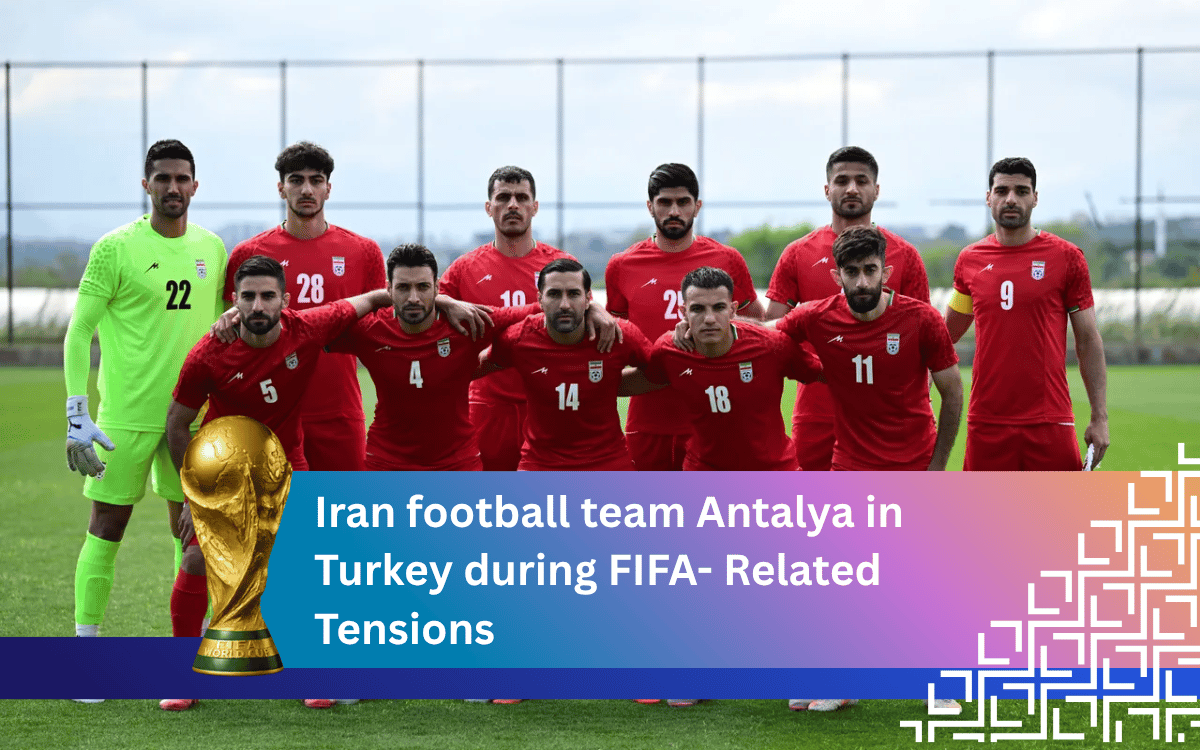
Iran football team Antalya became the focus of international headlines after players and officials staged an emotional pre-match tribute during a World Cup warmup against Costa Rica in Turkey. The gesture, observed in front of FIFA president Gianni Infantino, came amid heightened tensions linked to the ongoing conflict involving Iran, the United States, and Israel, turning a friendly football fixture into a highly symbolic global moment.
The Iran squad posed holding photographs of children they said were killed in recent airstrikes, while also participating in national anthem ceremonies before the match in Antalya. The event highlighted how football and geopolitics are increasingly intersecting on the road to the 2026 World Cup.
Emotional Tribute Before Costa Rica Friendly in Turkey
During the friendly match in Antalya, Iranian players and coaching staff—including head coach Amir Ghalenoei and federation officials—held up images of children allegedly killed in recent strikes. The act took place in a stadium without spectators but with FIFA president Gianni Infantino in attendance.
According to reports, the players also sang the national anthem while holding the photographs, creating a striking pre-match moment that quickly spread across global media coverage.
Earlier in the week, the team had also used symbolic items, such as backpacks, to honor victims of a separate incident in southern Iran, reinforcing a series of public gestures tied to national mourning and political messaging.
Iran went on to win the match 5–0, but the result was overshadowed by the pre-game demonstration and broader geopolitical context.
FIFA’s Gianni Infantino Attends Amid Political Sensitivity
FIFA president Gianni Infantino’s presence in Antalya added significant weight to the event. His visit came during ongoing discussions about Iran’s participation in the upcoming World Cup hosted by the United States, Canada, and Mexico.
Infantino has repeatedly emphasized that Iran will participate in the tournament despite rising political tensions. He has also expressed FIFA’s intent to maintain a unified competition structure, rejecting proposals to relocate matches away from the United States.
Reports indicate he met with Iranian players and officials during the visit, offering FIFA’s continued support for their preparations.
His attendance underscored FIFA’s balancing act between sport governance and global political instability, as questions continue to circulate about visas, security, and match logistics.
Rising Geopolitical Pressure Around Iran’s World Cup Participation
The Iran national team’s preparations for the World Cup have been repeatedly influenced by geopolitical developments. The conflict involving Iran and Israeli–U.S. military actions has raised concerns about player safety and travel arrangements, particularly because Iran is scheduled to play group-stage matches in the United States.
Iranian football authorities have reportedly explored alternative arrangements, including proposals to relocate fixtures to neutral venues such as Mexico. However, FIFA leadership has rejected any changes to the established tournament structure.
Despite uncertainty, FIFA has publicly maintained that Iran will remain part of the competition, framing participation as essential to the tournament’s global inclusivity.
Training Camp in Turkey as Strategic Neutral Ground
Turkey, particularly the Antalya region, has become a temporary base for Iran’s international preparations. The team has conducted training sessions and friendlies in the area under tight media restrictions, reflecting the sensitive political environment surrounding their fixtures.
Officials have stated that limiting media interaction is intended to keep focus on sporting performance and reduce external distractions during a critical preparation phase.
Matches against teams like Nigeria and Costa Rica were scheduled as part of Iran’s final build-up to the World Cup, with organizers adjusting venues due to regional instability.
Football, Politics, and the Growing Global Spotlight
The Antalya friendly highlights how international football is increasingly shaped by external political realities. What would normally be a standard pre-World Cup warmup instead became a global talking point involving:
- FIFA leadership engagement on-site
- Symbolic political gestures by players
- Ongoing war-related tensions affecting team logistics
- Uncertainty surrounding World Cup travel and venue arrangements
This convergence of sport and geopolitics places Iran’s national team under unique scrutiny as the 2026 tournament approaches.
What Comes Next for Iran Ahead of the World Cup?
As preparations continue, Iran’s focus will shift back to competitive readiness, but external pressures are unlikely to fade. FIFA has reaffirmed its position that the tournament will proceed as scheduled, with all qualified teams expected to participate.
However, questions remain around security protocols, diplomatic relations, and match-day logistics in the United States, where Iran is scheduled to play key group-stage fixtures.
For now, the Antalya match stands as a powerful reminder that global football is no longer insulated from international conflict—especially when teams arrive carrying both sporting ambition and national narratives onto the pitch.